Feast: Dev Log 1
Introductions and What's Been Done Already

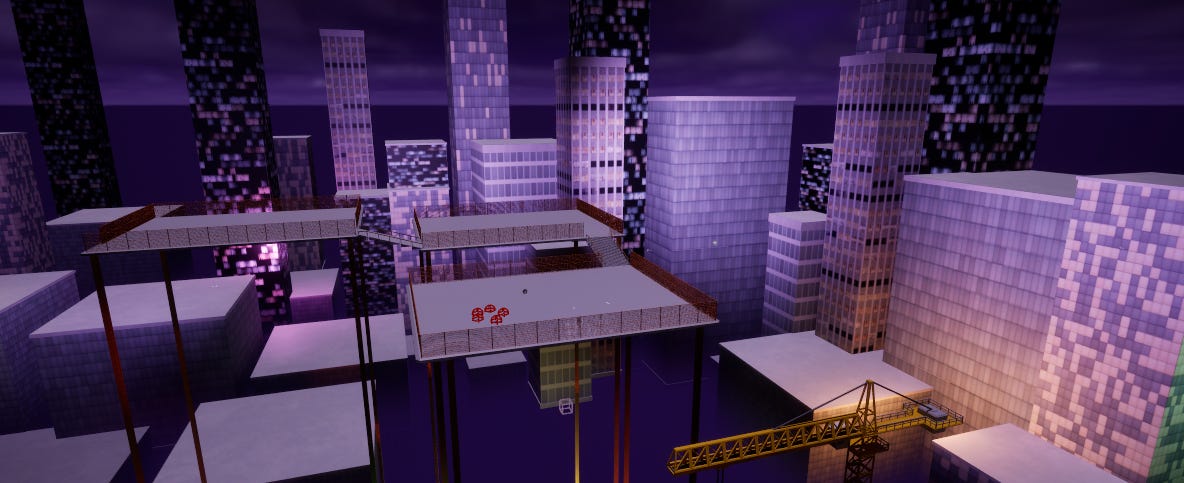
The first dev log is upon us! While Feast isn’t ready for its alpha release quite yet, I’ll be using this dev log series as a space to share some preliminary footage of what I’m working on, along with some notes about my process. Of course, I’ll also be getting into the nitty gritty with a change log at the end of each dev log (after this one of course), and when the game is available I’ll be announcing it here first.
If you’re sitting there asking yourself, “What even is Feast? Is it an FPS built in Unreal 5, one that’s inspired by boomer shooters like Doom with power-up elements from Kirby?” then I’d ask why you were in my apartment looking through my game project files. Though in that oddly specific hypothetical, you would be right!
Feast is the result of a long conversation I had about how “Power-Up” is potentially one of the vaguest terms in video games (I won’t clog this post up with too many details, that’s for another day). Like any good talk about nonsense it inspired me to make something, and that something is a game that features too many power-ups. Here is a clip featuring a base set of 6 power-ups that I’ve developed so far, set in the template I’ll be using for the first level.
Currently, Feast is very early in development (hence the slightly rough footage above!). I’ve focused on building the infrastructure that the game will use and a handful of useful test cases for those systems, along with a basic environment that will become the first level. I have a few more areas of Feast I’d like to implement before it’s ready for a public alpha build, and a few others that’ll be fleshed out even further still. Even still, let’s talk about what I’ve done so far!
WHAT I’VE DONE SO FAR
Part of this process for me was refamiliarizing myself with the processes of Unreal Engine 5, so I started by building a basic character controller! This was overall a quick part of the process as the character controller itself is fairly basic, but thankfully by building it myself I was able to more thoroughly integrate it with something that took much more of my time, the Power-Up system!
In order to make the process of constructing Power-Ups simple and efficient, I decided to build out the system using base templates. There’s a base actor that is placed within a scene, representing the physical object a player interacts with to receive a Power-Up, and then the effect which is slotted onto the base as an actor component. The actor components have been made with modularity in mind to ensure that future Power-Ups can be easily created using them as templates, though I also have plans to create a wider variety at a later date.
Currently, Power-Ups are divided into two categories: Damage and Utility. The player can hold one of each at a given time, and can swap them with a new one they find in the world. For the first build I’ve created four Damage Power-Ups and two Utility Power-Ups as simple test cases, though I’m hoping to create a wide variety of unique and engage Power-Ups later on in development (without it eating up too much of my time of course!).
The project also features a combination of stock Unreal assets and several under Creative Commons licenses, which are credited within the game itself (links will also be included below). With these I created the basic UI and part of the first area of the game, a basic cyberpunk style skyline. Many of these are temporary for the time being, but nonetheless have been essential in determining the visual identity of the game.
Since this is the introductory dev log I’m going to cut off here to keep things brief, though in later posts expect to hear more about the why and how behind my choices a bit less about the specifics of what.
WHAT’S NEXT?
There’s so much to put here I’d need to write a whole other dev log to hold it! To list a handful, in the next post you might be hearing about:
Menus and other UI updates
Implemented Enemy visuals and behaviors
Base Power-Up tuning and additional Power-Ups
A few other surprises might sneak in if you’re lucky. For now, thanks for reading and see you next time!